Audio Perception
Our sense of sound is also known as 'Audition'.
For us to hear something there needs to be 2 things. The first being a stimulus; pressurised sound wave.
Second being a receptor; hair cells.
Sound waves with lower frequency are further apart and ones with higher frequency will be closer together.
Lower frequency sound travels further
You can perceive high and low frequency sounds at the same time creating a complex sound wave
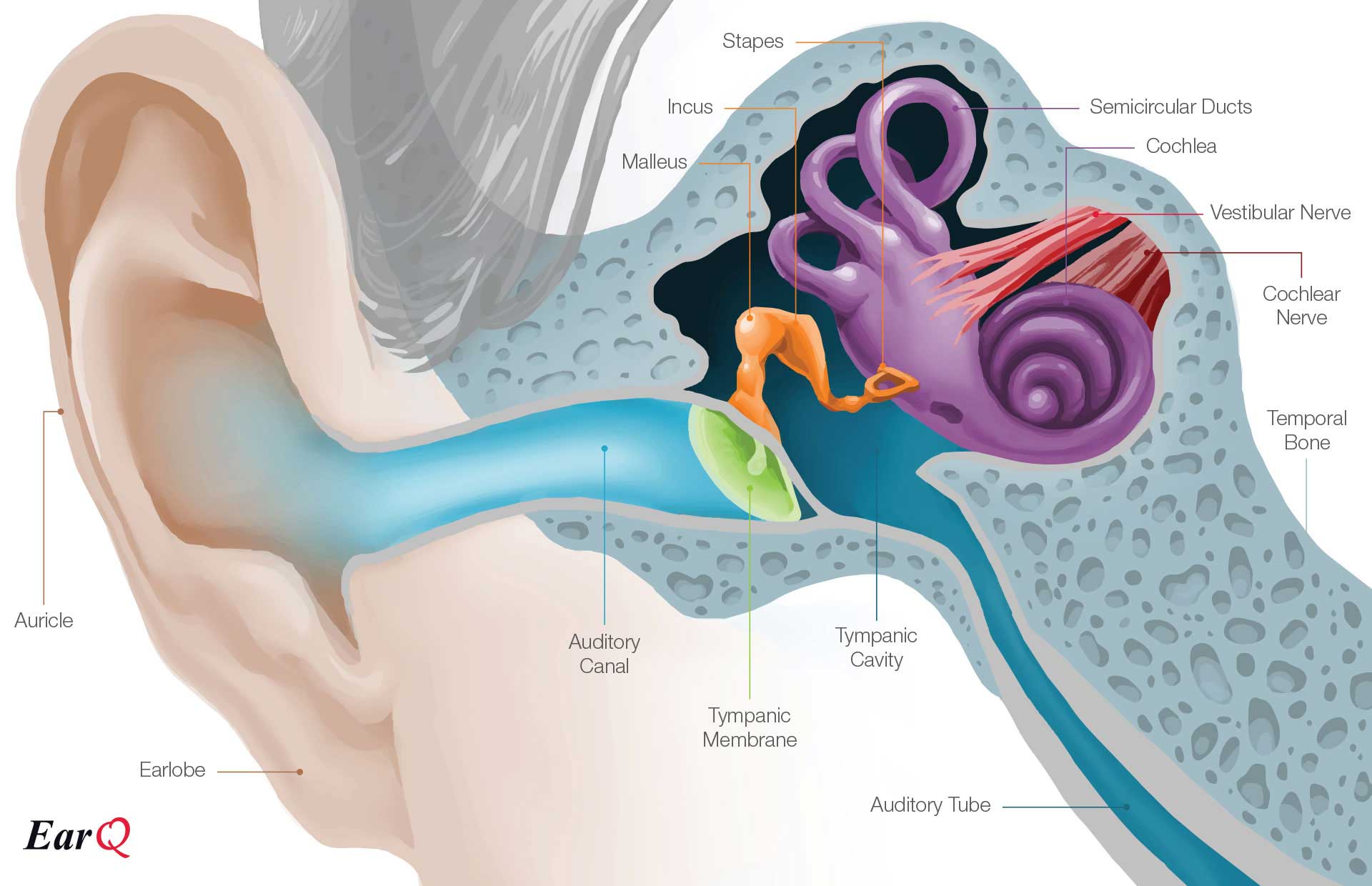
Sound waves will hit the outer part of the ear; the pinna. That sound wave gets funnelled into the auditory canal aka external auditory meatus and then hits the ear drum (tympanic membrane). As the pressurised sound wave hits the eardrum, the eardrum starts to vibrate. This causes 3 bones to vibrate also: malleus, incus and stapes. The stapes in attached to the elliptical window (oval window) which starts to vibrate also. The oval window is attached to the cochlea which has fluid. The vibration causes the fluid to be pushed round to the tip of the cochlea. When it reaches the tip, the fluid goes back but not to the oval window but to the circular window (round window). Eventually the fluid stops moving. The hair cells inside the cochlea were being pushed back and forth as the fluid passed through and that sends electrical impulses through the auditory nerve to the brain.
The reason why the fluid does not move back to the oval window is because in the middle of the cochlea there is a membrane.
The membrane is known as the organ of corti. It is composed of two things: basilar and tectorial
membrane.
Our sense of sound is also known as 'Audition'.
For us to hear something there needs to be 2 things. The first being a stimulus; pressurised sound wave.
Second being a receptor; hair cells.
Sound waves with lower frequency are further apart and ones with higher frequency will be closer together.
Lower frequency sound travels further
You can perceive high and low frequency sounds at the same time creating a complex sound wave
Sound waves will hit the outer part of the ear; the pinna. That sound wave gets funnelled into the auditory canal aka external auditory meatus and then hits the ear drum (tympanic membrane). As the pressurised sound wave hits the eardrum, the eardrum starts to vibrate. This causes 3 bones to vibrate also: malleus, incus and stapes. The stapes in attached to the elliptical window (oval window) which starts to vibrate also. The oval window is attached to the cochlea which has fluid. The vibration causes the fluid to be pushed round to the tip of the cochlea. When it reaches the tip, the fluid goes back but not to the oval window but to the circular window (round window). Eventually the fluid stops moving. The hair cells inside the cochlea were being pushed back and forth as the fluid passed through and that sends electrical impulses through the auditory nerve to the brain.
The reason why the fluid does not move back to the oval window is because in the middle of the cochlea there is a membrane.
The membrane is known as the organ of corti. It is composed of two things: basilar and tectorial
membrane.
Comments
Post a Comment